 Skip to content
Assisted bathing at home starts with a bathroom that has room for two. Whether you help a partner or parent wash, or paid carers visit to help someone you love, the layout of the room decides whether bathing is safe and dignified or a struggle for everyone involved.
Some of the families who contact us are washing a loved one with a bowl of water, or waiting for carers to arrive because the bathroom won’t let anyone help. Others have a walk-in shower, but there’s no space for a second person beside it.
In the last four years alone, we have fitted more than 770 bathrooms, and more and more of them include features that make room for a helper. In this guide, we’ll cover what makes a bathroom easier to help in, the features that matter most, the choice between a wet room, a walk-in shower and a walk-in bath, and what it all costs.
Let’s begin…
Contents
Assisted bathing at home: at a glance
- What matters most:
- Room for a second person, no step, and a seat to wash on
- Often the best layout:
- A wet room, with space for a carer and a wheeled shower chair
- Prefer a bath?
- A walk-in bath with a powered seat that lowers and raises the bather
- Keeping the carer dry:
- A half-height care screen or a shower curtain
- Time to fit:
- Three to five days for a wet room; a walk-in bath in as little as one day
What is assisted bathing?
Assisted bathing means washing with help: from a bathroom designed around the person, from equipment such as a powered bath seat or a fold-down shower seat, or from another person, whether that’s a partner, a son or daughter, or a paid carer. Most of the time, it’s a mix of all three.
At home, the aim is a bathroom where help can be given safely and with dignity, and where the person still does as much for themselves as they can. That’s what this guide is all about.
Assisted bathing can also mean a service outside of the home. Some councils and local charities run assisted bathing sessions, where staff help people to bathe in specially equipped bathrooms. Age UK Southampton is one example of this. These services can be a useful interim solution while a bathroom at home is being planned and eventually adapted.
What makes a bathroom easier for a carer to help in?
Space and access matter more than any single product. A bathroom is easier for a carer to help in when there’s room for a second person beside the bather, no steps to manage, nothing in the way, and a seat to wash someone on.
These are the needs families and carers mention to us again and again:
- Room for a helper. The thing people tell us most often is that there isn’t space for a carer to stand alongside. A shower that suits someone on their own can stop working the moment a second person needs to stand beside it, or in it, which is why some customers with a walk-in shower come back to us for a wet room design and installation.
- No step. Guiding someone over a raised tray or a bath side is hard for both people involved. A level floor also lets a carer wheel someone in on a wheeled shower chair.
- Nothing in the way. Sliding doors, curved screens and cupboards can block a carer’s reach. Open entry, or a hinged screen that opens fully, keeps the space clear.
- A seat to wash on. A sturdy seat, ideally with a back and arms, lets the person sit while the carer helps with the parts they can’t reach.
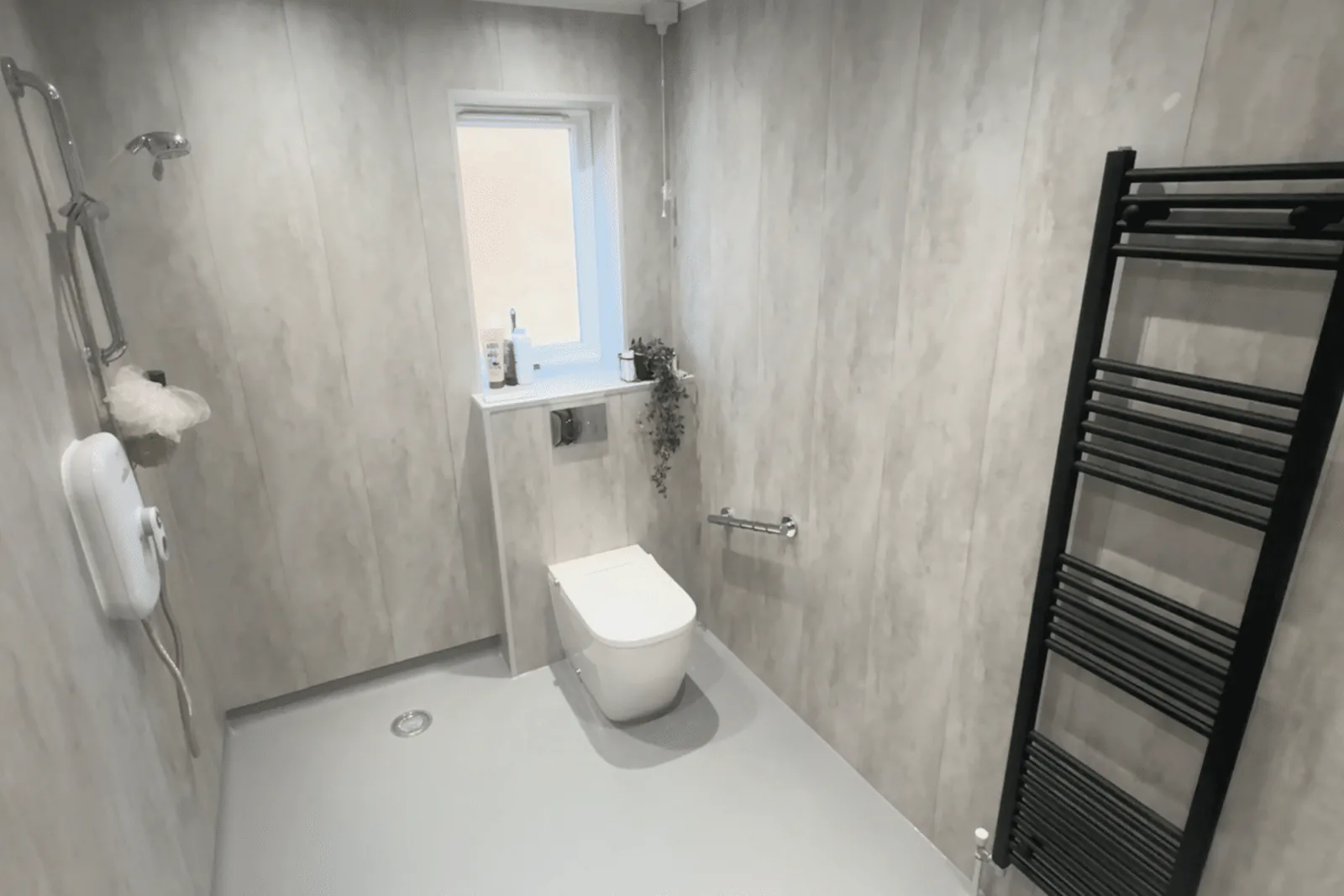
Sometimes the best answer is a different room. When one family asked about turning a small downstairs cloakroom into a shower room, our surveyor suggested using the upstairs bathroom instead, as there simply wasn’t space for their mum and carer together.
If you’re an occupational therapist or case manager arranging an adaptation for a client, our sister company, Age Care Pro, works directly with care professionals.
Which bathroom features help a carer most?
The bathroom features that help a carer most are a shower area wide enough for a chair and a helper, an open entry or a shower curtain, fold-away support rails, a half-height care screen, and shower controls the carer can reach without getting wet.
Here’s how often we fit each one, across all 772 bathrooms we installed between July 2022 and June 2026:
| Feature | How it helps a carer | How often we fit it |
|---|---|---|
| A shower area at least 1m wide on its shorter side | Room for a shower chair and a helper inside the shower area | 27% |
| A shower curtain | Keeps the entry fully open for a helper or a wheeled chair | 26% |
| A drop-down support rail | Folds up out of the way, so a helper can stand alongside | 16% |
| A half-height care screen | Keeps the water in while the carer reaches over to help | 11% |
| A wash-and-dry toilet | Takes one intimate task away from the carer, for more privacy | 6% |
These figures cover every bathroom we have fitted, not only those for people with carers, but they also show how often we design in room for a helper. Half-height care screens are the clearest example: we fitted 13 in 2023, and 30 a year in both 2024 and 2025.
Where the shower sits matters too. The Disabled Living Foundation suggests placing it where both the person and the carer can reach it easily, with a hose long enough for the carer to lift the handset off its rail. It also notes that a half-height screen lets a carer reach over to help with washing. A digital shower with a remote control can let the carer set the temperature before the person steps in, and a thermostatic valve keeps it steady throughout.
You can read more about some of these features in our guides to shower seats, grab rails and wash-and-dry toilets.
Wet room or walk-in shower: which is better for assisted bathing?
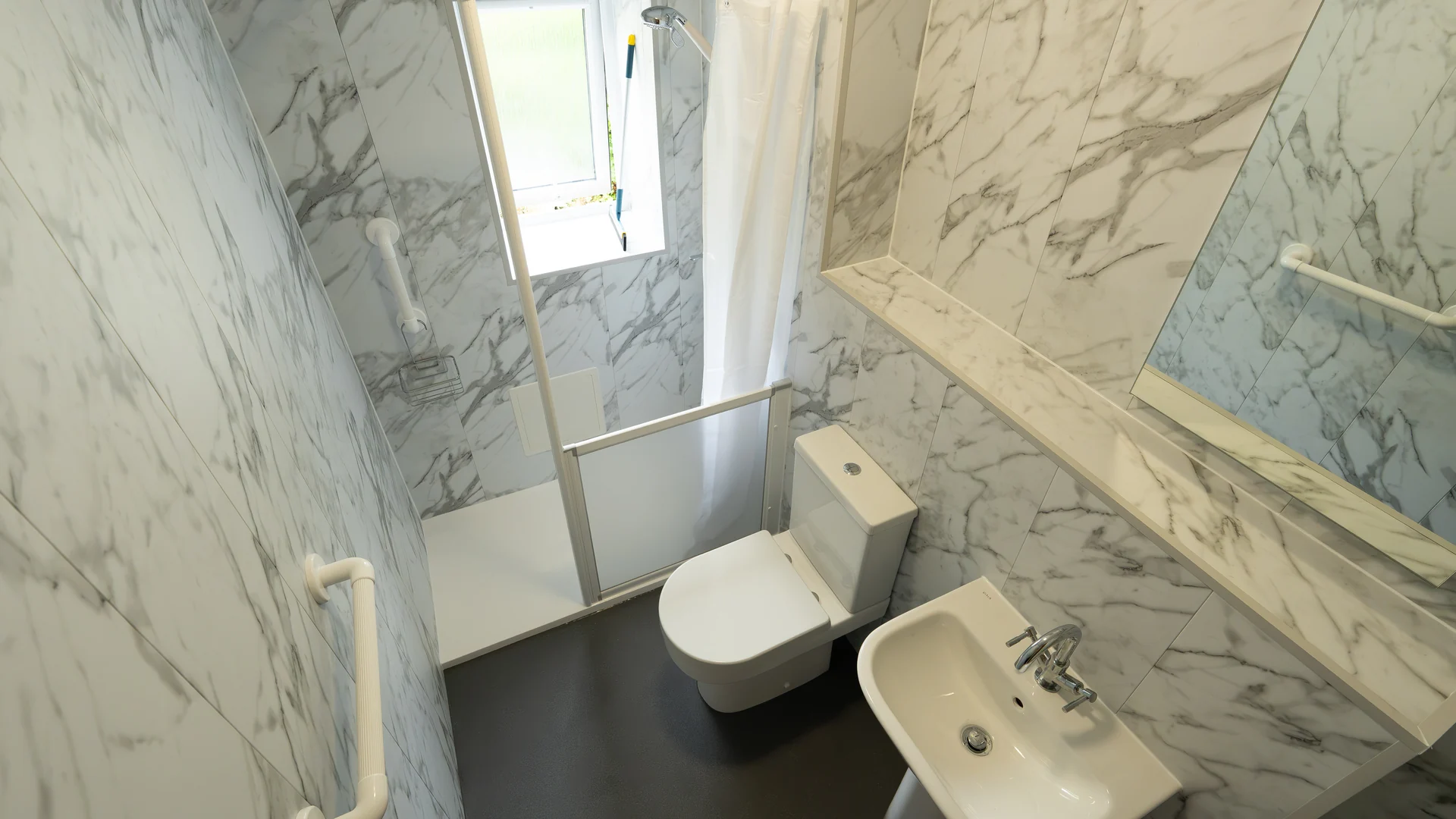
A wet room usually suits assisted bathing best, because its completely level floor leaves room for a carer to stand alongside and lets a wheeled shower chair roll straight in. A walk-in shower, with its low step, can work well where the person can still step in with a little help.
That’s the pattern we see. Where paid carers are involved, families most often ask us for a wet room. Where a husband, wife or grown-up child does the washing, a walk-in shower comes up more often, usually because of cost. One wife told us she would have liked a wet room to help her husband, but a walk-in shower fitted their budget.
Both can be designed around a helper. One carer job we completed had a low-step tray with a curtain on an L-shaped rail, a screen with a built-in grab pole, and a fold-away rail beside the seat. Two others started as a request for a walk-in shower or a low tray and finished as a wet room after discussions with our team.
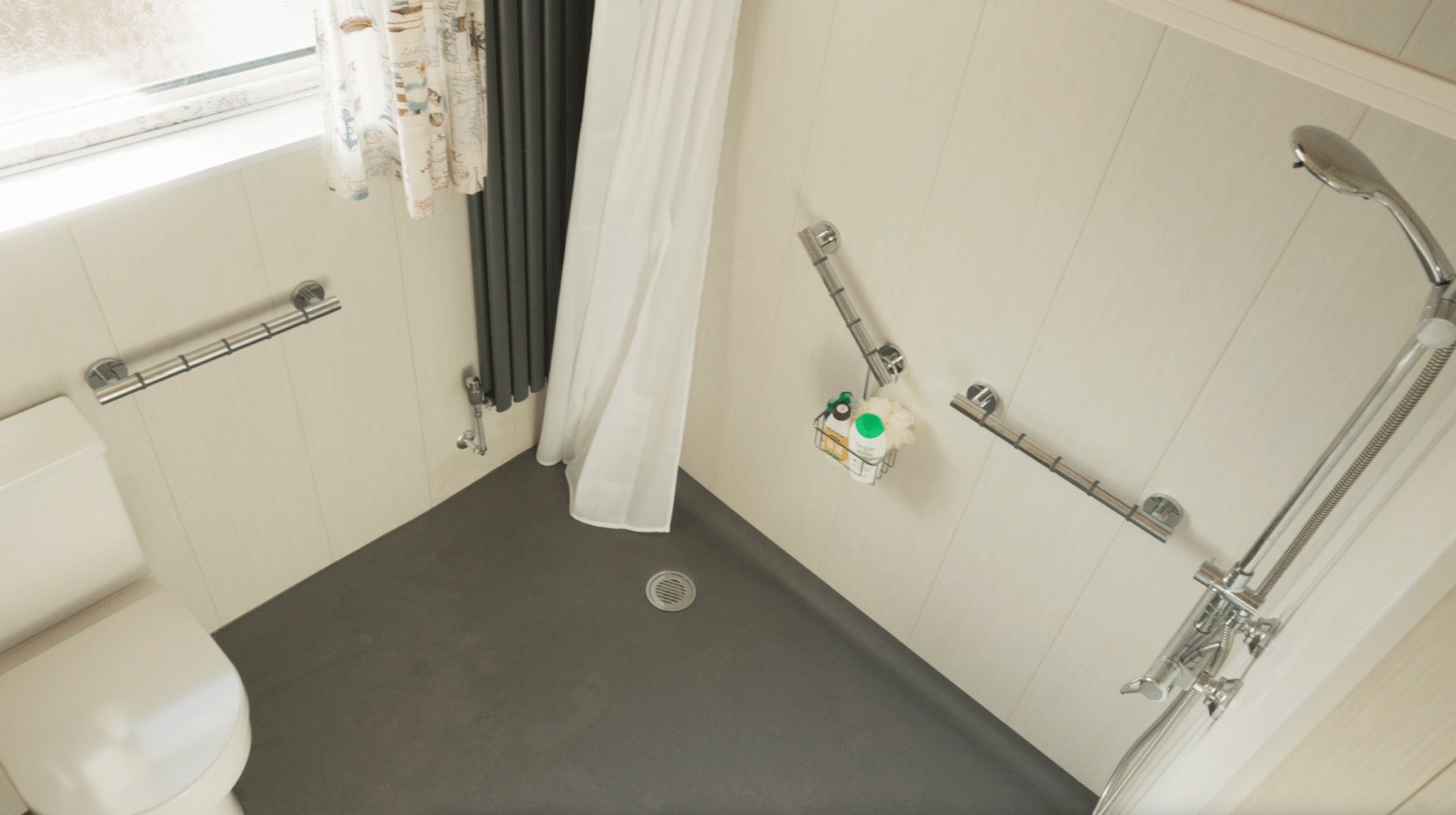
The one thing a wet room doesn’t do on its own is keep the carer dry. A half-height care screen or a shower curtain solves that, and many of the wet rooms we fit for carers have one or both.
You can compare the two on our walk-in showers and mobility wet rooms pages, and see a carer-friendly wet room in our guide to disabled wet rooms.
How does an assisted bath work?
An assisted bath, usually called a walk-in bath, has a low door that seals watertight and a built-in seat, so a carer can help someone bathe without having to lift them in and out.
A walk-in bath supports a carer in three main ways:
- It takes the lifting out of bathing. A powered seat lowers the bather into the water and raises them out again, so the carer guides rather than lifts. The Montana and Easy Riser have this feature built-in, and the Louisiana can have one as an option. The Omega has a powered seat-lift instead of a door.
- It makes getting in easier. A low step and a wide door mean the carer only needs to steady someone as they walk in and sit down, rather than help them over a high side. The Tennessee has the lowest step in our range, at 115mm, and some models sit at the right height for a side transfer from a wheelchair.
- It keeps the bather seated and supported. A built-in or ramped seat holds the person securely while the carer helps them wash, and thermostatic taps keep the water at a steady, safe temperature. The Tranquility has a ramped seat the bather slides onto, and compact baths such as the Florida fit a built-in seat into a smaller bathroom.
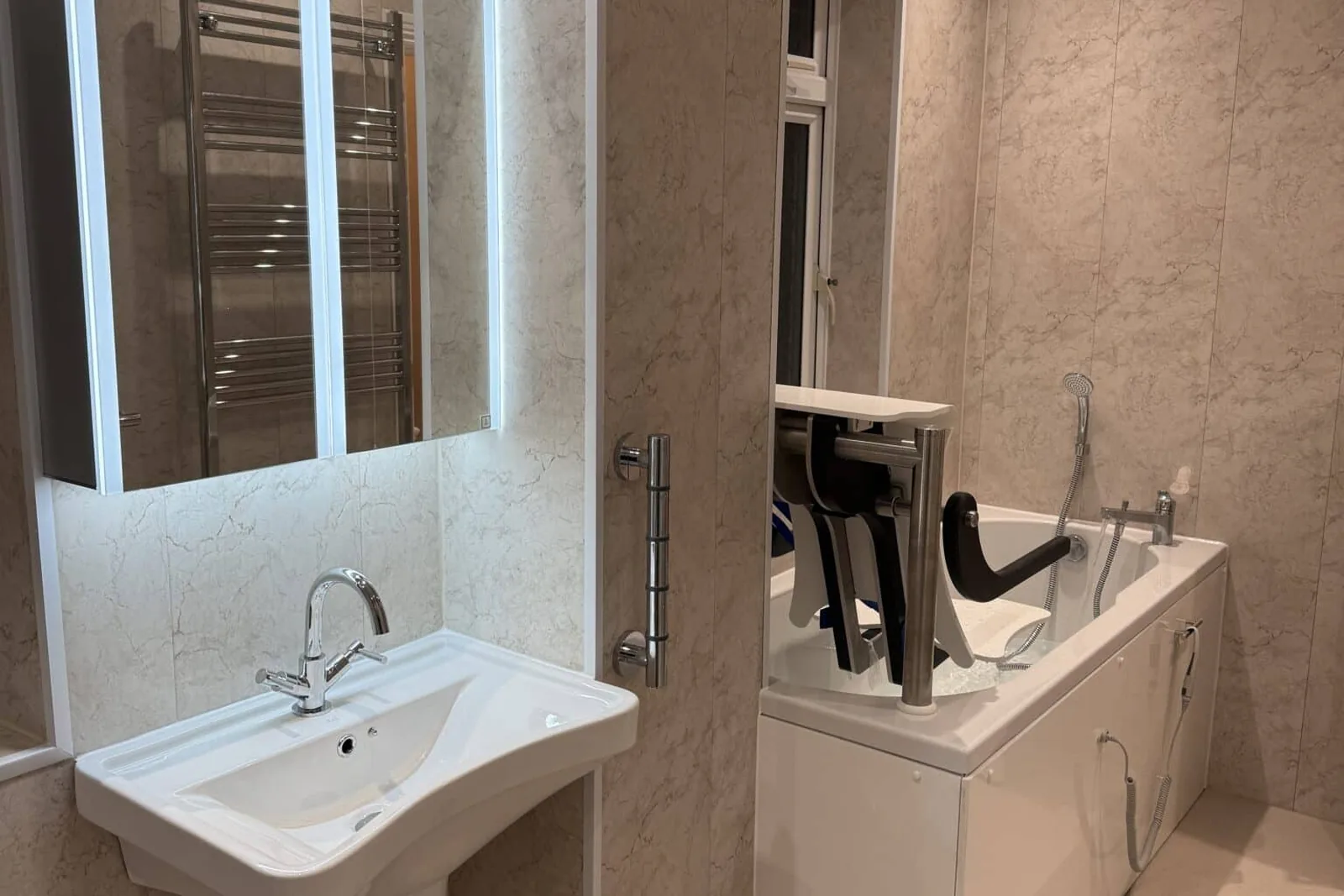
Some families with carers choose a bath for exactly these reasons. One of our customers with daily carers chose a compact Florida walk-in bath, and another family, where a relative is the carer, chose the mid-length Tennessee.
There are two important things to know first. The bather sits on the seat while the bath fills and drains. And the carer still leans over the side to help with washing, so a seat that raises the bather makes that much easier.
You can compare every model on our walk-in baths page, or read our guide to how walk-in baths work.
Watch Sam go through the Montana walk-in bath and its powered seat.
How do you bathe someone who can’t use the shower?
If someone can’t use the shower or bath, a carer can help them keep clean with a strip wash at the basin, or, if they can’t move easily, a bed bath. The NHS advises that if the person you care for can’t move or has very limited mobility, you may need to give them a bed bath, taking extra care when you move or handle them.
Some of the families who contact us are doing exactly this, because their bathroom won’t let anyone help. It works, but it takes time, and it’s rarely how someone wants to wash.
The right accessible bathroom can change that. A level floor, a seat and room for a helper can make a proper shower possible again, and the NHS notes that adaptations such as seats can make bathing less stressful. If you’re helping someone in and out of a bath now, it’s also worth getting advice on doing it safely, for your own health as well as theirs.
If you’re wondering how often someone needs a full wash, our guide to how often older people need to bathe covers it.
How much does assisted bathing cost?
Our walk-in baths start from £7,353, walk-in showers from £8,500, and a wet room from £10,000, fully installed. These prices cover the whole job: your new bathroom, supplied and fitted by our own employed team, taking out and recycling your old bath, and full aftercare. Care features such as a drop-down rail or a wash-and-dry toilet are priced as extras, but fitting them is covered, and your written price is the price fitted.
These prices are for customers who are VAT-exempt; if you don’t qualify, you’ll pay up to 20% more.
Cost does shape the choice for some families. Where budget is tight, a walk-in shower designed around a carer can do much of what a wet room does. You can find more in our guide to accessible bathroom costs and our ways to pay.
Will you pay VAT on an assisted bathing bathroom?
You won’t pay VAT on qualifying work if the person who’ll use the bathroom is chronically sick or disabled, under HMRC’s VAT Notice 701/7. It’s the person who’ll use the bathroom who needs to qualify, not the carer. HMRC’s definition doesn’t cover someone who is only temporarily disabled, or an older person who is otherwise able-bodied.
If they’re 60 or over and don’t qualify, you’ll pay a reduced rate of 5% VAT on some items, such as grab rails, a shower with a built-in seat, or a walk-in bath with a sealable door (HMRC rules for over-60s).
Use our VAT exemption checker to help see if you qualify; it only takes a couple of minutes.

Can the right bathroom help someone stay at home?
Yes. For some of the families we work with, an adapted bathroom is what lets someone stay in the home they love, or come home after a stay in a care home. When a carer can help safely, bathing is no longer the thing that holds everything else back.
We’ve fitted bathrooms for families doing exactly that. As one customer wrote about the shower room we fitted for her husband, the new bathroom was a “crucial factor in him being able to return home”.
Research supports what we see. An NIHR-funded study found that older people who had their bath replaced with a level-access shower sooner, rather than waiting, reported better mental wellbeing, more independence in bathing and a better quality of life. The researchers advise reading the results with some caution, but the direction is clear: the sooner the bathroom works, the better.
If you’re weighing up the options, our guide to how the cost of adapting a bathroom compares with care home fees sets out the figures. And for care homes and assisted living settings, our sister company Age Care Pro designs bathrooms for residents and staff.
Assisted bathing at home: your questions answered
Can a carer or family member come to the home visit?
Yes, and we'd encourage it. A carer or family member who helps with bathing can show us how they help now, so we can design the bathroom around both of you. If an occupational therapist is involved, we're happy to work from their recommendations too.
Is there room for a hoist in a wet room?
Often, yes, because a wet room's level floor and open layout give the most space to work in, but it depends on the size of the room. If the person you care for uses a hoist, tell us at the home visit, so we can plan the layout around it alongside their occupational therapist's advice.
Can a bathroom be adapted again if care needs change?
Yes, and it helps to plan for it from the start. A layout with room for a second person, or a half-height care screen that also takes a curtain for times when no help is needed, means the bathroom can keep working as needs change. Tell us at the home visit how things might change, and we'll design with that in mind.
Ready to plan assisted bathing at home?
Whether you’re caring for someone now or planning ahead, we’re here when you’re ready. Book a free home visit, and we’ll measure up, talk through how you help, and design a bathroom around you both, with no pressure to go ahead. Carers and family members are always welcome. Or call our friendly team for free to discuss your options on 0800 999 8994.
We Cover the Whole of England & Wales
Our head office is in Chesterfield, Derbyshire, and our employed, DBS-checked installation teams travel right across England and Wales.
We don't currently cover Scotland, Cornwall, or the Plymouth and Torbay areas. Pop your postcode in below to check we can visit you.
- Free home visit
- No obligation
- Employed, DBS-checked fitters
Not sure? Call us free on 0800 999 8994 and we'll confirm.
Let's get you a free home visit booked in with one of our expert surveyors