 Skip to content
When mobility begins to change, many families find themselves at a difficult crossroads centred around one major question: “Is it time to consider a care home, or can we adapt the home we already love?”
At Age Care Bathrooms, we are a part of this conversation every day. We understand that for the vast majority of older adults, the preferred choice is to remain at home, surrounded by familiar comforts and memories. However, safety is the non-negotiable factor that often forces a move. If the bathroom has become a place of anxiety or a “no-go zone” due to high bath sides or slippery floors, the pressure to relocate grows.
In this guide, we’ll compare the one-off investment of a mobility bathroom renovation against the ongoing costs of residential care in 2026. By looking at the numbers and their impact on independence, we hope to help people decide which path is right for them and their family.
Contents
Understanding the Investment: What Does a Mobility Bathroom Cost?
One of the most significant advantages of adapting your home is that it comes at a cost that can be a one-off payment. Unlike care fees, which recur every week for the rest of your life, or a loved one’s life, a mobility bathroom is designed to future-proof your home for a decade and beyond.
While every installation of an accessible bathroom we complete is bespoke to the user’s specific health needs, room, and layout, we believe in being transparent about prices to help you plan. Here is what you can expect for a full professional installation of a mobility bathroom, including design, high-quality fixtures, and expert workmanship:
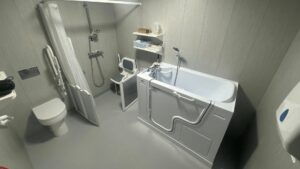
- Walk-in Bath design and installation: Starting from £7,353.
- Walk-in Shower design and installation: Starting from £8,500.
- Full Wet Room design and installation: Starting from £10,000.
These prices cover more than just the plumbing; they include the peace of mind that comes with DBS-checked specialists and a comprehensive 12-month aftercare package and warranty. If you view these as fixed costs, the financial comparison and contrast with residential care is very different.
The Growing Cost of Residential Care in the UK
Residential care costs in the UK have reached record levels in 2026. For many families, these fees represent a significant drain on life savings and property equity. Unlike a bathroom renovation, these costs are a subscription to a lifestyle that you can’t just opt out of once you or a loved one has moved in.
Looking at the latest 2026 data from carehome.co.uk and market analysts at Lottie, the average weekly fees for self-funders have risen across every region of the UK.
- Standard Residential Care: Average £1,298 per week (approximately £67,496 per year).
- Nursing Care: Average £1,535 per week (approximately £79,820 per year).
- Dementia-Specific Care: Average £1,343 to £1,564 per week.
To put this into perspective, the cost of just 6 to 10 weeks in a residential care home is equivalent to the entire cost of a brand-new, walk-in shower.
While a bathroom installation can be a single payment or paid using finance options, with a completed date, care home fees continue month after month, year after year, without a clear end to the commitment.
This is a big financial reality, and why many families are now looking to home adaptations as the go-to for keeping their independence, and for the family, their inheritance.

Side-by-Side: The Financial Comparison
When you look at the figures over a longer period of time, the cost of a mobility bathroom installation starts to look less like an expense and more like a big saving. To show this, we’ve compared the one-off starting cost to one of our popular solutions, a walk-in shower, against the cumulative cost of residential care.
| Timeline | Mobility Bathroom (One-off) | Standard Residential Care | Nursing Care Home |
|---|---|---|---|
| Month 1 | £8,500 | £5,192 | £6,140 |
| Month 2 | £0 | £10,384 | £12,280 |
| Year 1 | £0 | £67,496 | £79,820 |
| Year 2 | £0 | £134,992 | £159,640 |
As the data shows, a mobility bathroom will pay for itself in less than eight weeks. By the end of the first year, the savings from staying at home could effectively fund other home renovations to make it more accessible or be preserved as part of family inheritance.
The source data used in the table above is based on findings from Lottie’s 2026 Care Fee Guide and Elder’s 2026 Cost Report.
Best of Both Worlds? Bathroom Adaptations & Live-in Care
We understand that for some, the choice isn’t just about the physical environment; it’s also about the need for daily support. Although needing help with medication, meals, or bathing doesn’t automatically mean that a move to a care home is the only option.
Many of our customers are choosing to utilise a hybrid model: adapting the home with a safe, accessible bathroom and employing Live-in Care.
According to Elder.org, live-in care often starts around £1,095 per week. When you combine this with a one-off bathroom adaptation, the benefits include:
- Safety for the Carer: A level-access wet room makes it safer for everyone involved, and the live-in carer to assist with bathing, reducing the risk of injury.
- Cost Efficiency: Even with the cost of a carer, staying at home is often still thousands of pounds cheaper per year than a full-time residential placement, all while allowing you or a loved one to stay within the community that they’re familiar with.
Restoring Independence: What the Research Says
The decision to stay at home isn’t just a financial one; it’s backed by significant academic research. A study funded by the National Institute for Health and Care Research (NIHR), known as the “Bath-out” study, looked at the impact of replacing a traditional bath with a level-access shower.
Its findings showed that providing a level-access shower quickly significantly improved the quality of life and mental well-being of older adults.
Further research of the study published in this article highlights that:
- Dignity in Daily Living: Self-care, especially bathing, is a cornerstone of dignity. Adaptations that allow an individual to bathe themselves or be assisted more easily delay the need for residential care.
- Psychological Wellbeing: The ability to remain in a familiar environment reduces the “transfer trauma” often associated with moving into a care facility.
Investing in a mobility bathroom is an investment in a proven method of helping to maintain mental health and physical independence.
A Look at Installation Time vs Care Home Placement
When safety becomes an issue, it’s important to get it resolved quickly. The process of moving into residential care, unfortunately, isn’t known for speed. Finding the right home, undergoing local authority assessments, and managing the time from enquiry to placement can take weeks or even months.
According to insights from TrustedCare, the journey to find the ideal care placement is often complex and a rollercoaster of emotions for families.
Compare this to the timeline of a bathroom adaptation. At Age Care Bathrooms, our goal, once consultation, understanding your needs and design is confirmed, is to install your new accessible bathroom as quickly as possible.
- A full accessible bathroom transformation can be installed by our team in three to five days, on average.
- A walk-in bath installation can be completed by our team in just a single day.
Instead of spending months on a waiting list or touring care homes, a permanent bathroom solution can be in place in a matter of weeks, from consultation to completion.
Why the Bathroom is the Critical Space
At Age Care Bathrooms, we understand that the move to residential care is often a gradual decision made after seeing a slow decline in a loved one’s wellbeing, usually at a point where the risk of an accident at home starts to outweigh their desire for independence. The bathroom is one of the riskiest rooms in the home for these accidents. According to public health data, one in three adults over the age of 65 (and one in two over 80) will experience a fall this year.
By making the bathroom safer before an accident occurs, you significantly reduce the risk of a “forced” move into care. Here is what we consider when planning a safe bathroom space:
- Remove the Trip Point: Replacing a traditional high-sided bath with a level-access shower or wet room eliminates the dangerous task of balancing when stepping into a traditional bath.
- Slip-Resistant Flooring: We use specialised, high-grip flooring that maintains traction, even when wet, a feature that standard tiles can’t provide.
- Support when it matters: Strategically placed, load-bearing grab rails provide stability at the exact moments you need to sit, stand, or pivot.
The effectiveness of this proactive approach is again backed by the “Bath-out 2 study”, which found that a bathroom adaptation resulted in a 70% reduction in falls among participants.
Summary: Making the Choice That’s Right For You
The choice between a mobility bathroom adaptation for the home and going into care has many factors associated with it. For many, a care home offers an important and valuable service, but it comes at a high financial and personal cost.
Looking at the 2026 landscape:
- A Care Home is a recurring expense of £67,000 to £80,000+ per year.
- A Mobility Bathroom is a one-off investment (starting at £7,353) that restores your dignity and allows you to stay in your own home and community.
Whether you choose a walk-in shower, a wet room, or the hybrid model of home adaptations combined with live-in care, you are choosing to protect your routine, your home, and your savings.
Ready to stay in the home you love?
We hope this comparison has provided you with the clarity you need to make an informed decision for you and your family. If you are ready to see how a safe, beautiful bathroom could change daily life, we are here to help.
To discuss your options or book a free home design consultation with our friendly team, please call us on 0800 999 8994.
We Cover the Whole of England & Wales
Our head office is in Chesterfield, Derbyshire, and our employed, DBS-checked installation teams travel right across England and Wales.
We don't currently cover Scotland, Cornwall, or the Plymouth and Torbay areas. Pop your postcode in below to check we can visit you.
- Free home visit
- No obligation
- Employed, DBS-checked fitters
Not sure? Call us free on 0800 999 8994 and we'll confirm.
Let's get you a free home visit booked in with one of our expert surveyors