 Skip to content
For many homeowners, maintaining independence means having a bathroom that is safe, stylish, and most importantly, easy to use. If you are starting to find high-sided baths a struggle or looking to future-proof your home for the years ahead, a wet room is often a great solution.
However, a common concern we hear from time to time is: “Can a wet room be installed upstairs and not leak through the ceiling?”
A reasonable question for many customers looking to have a wet room upstairs, the idea of a “floor-less” shower on an upper story can be daunting.
Fortunately, as we’re accessible bathroom specialists, we can provide the answers.
In this guide, we’ll explain how having a wet room upstairs is a possible reality, the technical hurdles involved, and, finally, why it could be the best option for your comfort and safety.
Contents
Can You Have a Wet Room Upstairs?
The short answer is yes. In most UK homes, it is entirely possible to install a wet room on an upper floor. However, because water naturally wants to travel downwards, the installation of a wet room upstairs requires a higher level of technical precision than a wet room installed on the ground floor of a home.
At Age Care Bathrooms, we regularly design and install wet rooms upstairs for those who want to maintain their independence without compromising the structure of their home.
How is it Structurally Possible to have a Wet Room Upstairs?
Most modern and traditional homes in the UK can support a wet room upstairs. The key factor is the condition and layout of the floor joists. Unlike a ground floor, which is often solid concrete, upstairs floors are typically made of timber joists with floor boards on top.
A common myth is that a wet room is “too heavy” for an upstairs ceiling, but, in reality, a wet room can often reduce the load on your floor. A standard bath filled with water is significantly heavier than the materials used in a modern wet room installation.
Before work can begin, the installation team must carry out a full structural assessment to check:
- Floor Strength: Ensuring joists can support the new level-access floor.
- Joist Direction: This determines how the drainage pipes will run.
- Plumbing Routes: Checking the proximity to the soil stack for efficient waste removal.
- Ceiling Height: Making sure that there is enough space below the floorboards to house the drain.
The Pros and Cons of an Upstairs Wet Room
To help you decide if a wet room upstairs is the right move for your home, we have put together some of the benefits and challenges.
The Benefits of a Wet Room Upstairs
Level Access Safety
The primary benefit for those with mobility issues is the removal of the shower tray, which can be a trip hazard. With a wet room, you get a perfectly flat floor from the landing to the shower.
Proximity to the Bedroom
Most people prefer to bathe near where they dress. Keeping the wet room upstairs avoids the need to navigate stairs every time.
Maximising Small Spaces
In small upstairs bathrooms, removing bulky bath or shower trays opens up the room, making it easier for wheelchair users or carers to move around.
Property Value
A professionally installed wet room is seen as a luxury, high-end feature that can increase the appeal of your home.
The Challenges of a Wet Room Upstairs
Complex Waterproofing
As there is a living space below, the “tanking” (waterproofing) must be 100% perfect. It is important to make sure the installer of the wet room is reputable and a specialist in this area, like the team here at Age Care Bathrooms.
Professional installation is essential. Poor waterproofing is not a wet room issue; it is an installation issue.
Structural Modifications
In some older homes, joists may need reinforcing to accommodate the drain, which can add to installation time.
Plumbing Constraints
If your bathroom is far away from the main soil pipe, installers of the wet room may need to put in place a quiet, low-profile pump to help the water move along the pipes.
How Much Space is Needed for a Wet Room Upstairs?
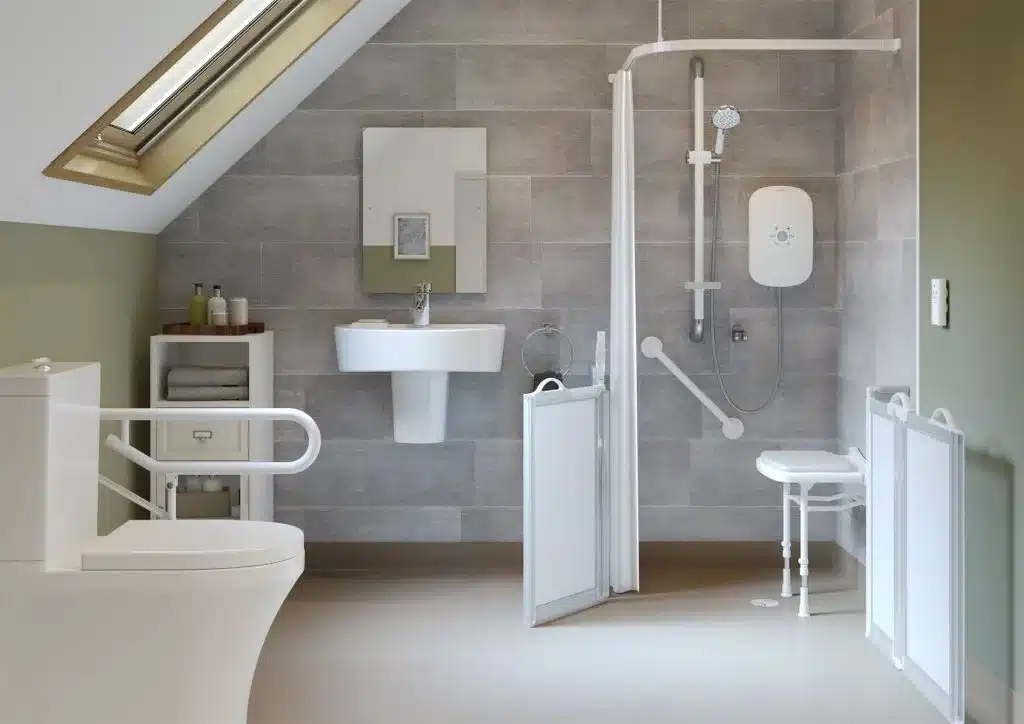
Another common question we have is “Is my bathroom too small for a wet room?”
The answer is rarely “yes”. Usually, it is the opposite; wet rooms are ideal for small upstairs bathrooms.
Let’s take a closer look:
- Small Bathrooms (around 1.5m x 2m): By removing the bathtub, you create a much larger “turning circle,” which is vital for those with mobility issues.
- Large Bathrooms: You’ll have the luxury of creating a “dry zone” and a “wet zone” and perhaps the possibility of keeping a separate bath for other family members while having a dedicated level-access shower area for yourself.
Is Planning Permission Required for an Upstairs Wet Room?
In almost all cases, no planning permission is required for a wet room upstairs.
However, building regulations do apply, particularly around drainage, ventilation, and electrical safety. This ensures the new wet room is safe and ventilated correctly to prevent mould.
Our team will handle all of these compliance details for you as part of our professional wet room installation service.
Is an Upstairs Wet Room Right for You?
Let’s consider whether a wet room installation upstairs is right for you. It isn’t always the best solution for everyone, as different requirements result in different accessible bathroom solutions.
An upstairs wet room is an ideal solution if:
- You want to keep your bathing facilities on the same floor as your bedroom.
- Stairs are becoming more difficult, but you want to stay in your own home.
- You want to “future-proof” your property without losing style.
- You need a more accessible bathroom that accommodates a wheelchair or walker.
Can You Have a Wet Room Upstairs? A Summary
Having a wet room upstairs is not only possible, but it is often the most practical long-term solution for maintaining independence and comfort at home.
With the right design, materials, and installation team, all of which can be provided by Age Care Bathrooms, a wet room upstairs is just as reliable and safe as a wet room on the ground floor of your home.

Would You Like to Know if Your Home is Suitable?
At Age Care Bathrooms, we offer a free home design consultation where we assess your home and talk through the best options for you.
We handle everything from the initial consultation and design to the final installation, making the process stress-free and easy.
Call us today on 0800 088 5901 or utilise our booking form, and our team will be happy to discuss your requirements.