 Skip to content
Managing everyday life with a disability can be extremely challenging, and everyday tasks such as bathing for disabled adults often require thoughtful adaptations. Showering becomes particularly difficult without a properly designed disabled shower that supports safe, independent movement.
Whether you’re searching for mobility showers that reduce fall risk or replacing a standard bath with a fully accessible solution, this guide will help you understand the different types of disabled showers and how to transform your bathroom into a safe, comfortable and futureproof space.
Let’s get started!
Contents
What are the Key Considerations When Choosing a Walk-In Shower for Disabled People?
When designing an accessible bathroom with disabilities in mind, consider the following factors:
- Bathroom Space: Assess the size of your current bathroom and the space available for a new shower.
- Physical Abilities: Consider how long the user can stand, whether they can lift their legs over a bath, and how far they can reach comfortably.
- Type of Disability: Identify any additional features or equipment needed based on the specific mobility or health condition.
- Disruption Level: Over-the-bath showers are less disruptive to install than walk-in showers or wet rooms, but longer-term needs may justify the initial inconvenience.
- Cost: Over-the-bath showers are often the most affordable option, while wet rooms tend to be more expensive. Walk-in showers fall in the mid-range, and our guide to walk-in shower costs breaks those prices down.
- Style: Functionality and aesthetics both matter. Choose a design that enhances comfort and confidence.
- Household Use: If others share the bathroom, select a shower that accommodates everyone’s needs.
No matter which option you choose- over-the-bath shower, walk-in shower, or a wet room it’s vital to consider how your needs may evolve in the future.
A well-designed bathroom that is adapted for disabled users allows for safety, independence, and dignity in everyday routines.
Why Choose a Walk-In Shower Instead of a Standard Shower?
Upgrading to a walk-in shower that is adapted for people with disabilities provides far more safety and confidence than a standard cubicle.
These mobility showers are specifically designed to reduce slips, remove tripping hazards and support independent movement.
Features such as anti-slip flooring, level-access trays, supportive seating and easy-reach controls make daily bathing for disabled adults significantly easier and safer.

There are 5 Types of Accessible Showers for People with Disabilities
Walk-in showers for older adults and people with disabilities can be adapted to suit a wide range of mobility needs and existing bathroom setups.
Here are five popular types of showers used in disability bathrooms that we have designed and installed:
1) Low-level Accessible Showers
These showers feature trays no more than 40mm high, making them easier to step into and reducing the risk of tripping. Ideal for people who don’t need a wheelchair but benefit from safer entry and exit. They’re compact and quick to install, even in smaller bathrooms.
Compared to traditional shower enclosures, disabled showers offer enhanced usability for people with limited mobility. Standard showers often include raised lips, narrow doors or slippery trays, while mobility showers are built to allow comfortable entry, stable seating and safe washing without strain.
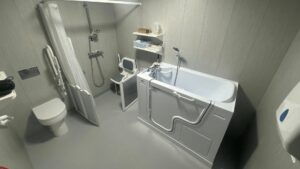
2) Walk-In Baths with Shower Fitted
Walk-in baths can combine bathing and showering for those who want both options.
Overhead showers can be added to easy-access walk-in baths. For users with severe disabilities, rising ergonomic seats can assist with safe transfers. Shower controls are positioned within reach, making these baths ideal for wheelchair users and those with limited upper body strength.
3) Mobility Wet Rooms
These mobility bathrooms have no raised shower tray and sit flush with the floor, ideal for wheelchairs and for reducing fall risk. Wet rooms maximise space in smaller bathrooms and remove barriers that may limit movement. They also allow carers more room to assist users if needed.
If you are a wheelchair user, our guide to wheelchair accessible showers explains the options available and the space you need further.
4) Walk-In Showers with Cubicles
Cubicles offer more privacy while remaining accessible. Corner cubicles are ideal for saving space, while three-sided enclosures provide flexibility in placement. They can be combined with grab rails, fold-down seats, and other safety features for a fully tailored solution.
5) Thermostatic Mixer Showers
These regulate water temperature automatically to prevent scalding. They’re perfect for multi-user households. RNIB-approved models feature raised markings and sound cues for the visually impaired. Electric showers are another safe option for consistent temperatures even when household water usage changes.
How to Enhance Shower Safety for People with Disabilities
The idea of installing a walk-in shower for yourself or a loved one is just the start. There are many features and adaptations to consider and include as part of the installation that can make your new accessible bathroom even safer and easier to use. For the wider picture across every kind of bathroom, see our guide to bathroom adaptations for older adults and people with disabilities.
Let’s take a look at some of our team’s recommended additions.
Popular Mobility Aids for Walk-in Showers for the Disabled
If getting around your shower is becoming difficult, it’s time to make a change. To improve your shower and bathing experience, we provide a range of mobility aids and safety features. Below are some of the most popular mobility aids that, when used with accessible showers, can help keep you or someone you care for safe and comfortable when showering.
- Shower head holders: Adjustable shower head holders allow the shower head to be positioned at a height that suits the user.
- Shower screens and enclosures: For additional privacy, a shower screen or enclosure can be portable or fixed. They come in various configurations and are ideal for wet rooms and walk-in showers.
- Long-handled bathing aids: There is a wide selection of long-handled bathing aids with handles of different lengths, such as sponges and bath brushes. For a person with limited mobility, they can make washing easier and reduce the need to stretch or twist, which may cause discomfort and increase the risk of a fall.
- Leg lifters: Moving your legs when seated on a chair or swivel chair over the bath’s rim can be easier with leg lifters. You use a reinforced strap with a loop at one end and then physically lift your leg into the bath.
- Anti-slip mats and flooring: In every bathroom, anti-slip mats or anti-slip flooring can help prevent slips and falls. We have many different anti-slip flooring options and supply a range of anti-slip mats.
- Grab bars: Provide extra support around the bathroom. These are often placed on walls around the shower or bath area and come in two types:
- Horizontal rails: Great for both walk-in showers and baths. They can help you push up from a sitting position and also provide additional support when sitting down.
- Vertical rails: They can be placed around the bathroom for extra support. Having them next to a shower seat can be very helpful and will stop you from slipping.
- Transfer boards: Also known as a sliding board or transfer slide, these are designed to help disabled people move safely and easily from a wheelchair to a bath or shower seat. They are particularly useful for those with limited mobility or strength, enabling them to transfer independently or with minimal assistance.
- Shower boards: These are designed to fit over the top of your bath and act as a seat so you can sit down and shower in your bath. They are suitable for most styles of baths without fixed shower screens.
- Swivel bath seats: If you require extra support, swivel bath seats fit over the bath and swivel inwards. They are great for back support and also act as an armrest. These seats are set in a fixed position and do not lower into the bath.
Walk-In Shower Seating Options for Disabled People
Sitting down in a walk-in shower adapted for disabilities can change showering from a difficult experience to an enjoyable one in comfort and independence.
Various seating options are available, and the best shower seat will depend on your individual needs.
Below are five main shower seating options to consider:
- Shower stools: These are available in various sizes and styles, including corner shower stools. Folding shower stools are also available, which take up less space if you want to put them away when not in use.
- Wall-mounted shower seats: These are classified into two types: static and hinged. Certain models will have back support and armrests, but you should check with the manufacturer to see if there are any weight restrictions.
- Shower chairs: You can choose from static or mobile shower chairs in all shapes and sizes. All shower seats will come with rubber cups on the legs to prevent any slipping and may be more suitable for a person who can’t use a wall-mounted shower seat due to weight restrictions. For extra comfort, most shower chairs come with armrests and padded seating.
- Shower chairs on wheels: They are perfect if you want to move the chair around and have the security of knowing it will not move once you have put it where you want to sit in the shower. These tend to have metal frames and plastic seats and are generally smaller than a standard shower chair.
- Self-propelled shower chairs: Available in many styles and designs, these are typically multi-functional. A popular choice is a self-propelled commode chair, which can be folded when not in use. For independence and dignity, they are designed so the user can propel themselves into the shower. Self-propelled shower chairs can also be pushed by someone else and will travel across carpet, tiles and lino.
Our Top Showering Tips for People with Disabilities
Improving shower safety for those with mobility issues involves several key considerations.
Here are some things that can help make showering safer for people who have disabilities:
- Ensure that the shower seat is stable and does not wobble; a fixed folding shower seat is an excellent option if other people in the household prefer to stand in the shower.
- Keep showering products, such as soap, razors and shampoo, in a holder on the wall close to the shower controls for easy access.
- Take your time getting on and off the shower seat, and use grab bars and anti-slip mats to help prevent slips and falls.
- Distribute weight evenly and avoid sitting on the edge of the shower seat or chair.
Need Support Choosing the Right Walk-In Shower for Your Disability Requirements?
Making bathroom modifications for a disabled person, or yourself, doesn’t have to be a stressful process.
At Age Care Bathrooms, you don’t have to sacrifice design for functionality. Our team of bathroom specialists is dedicated to helping you choose the best accessible shower or mobility bathroom to meet your needs and budget.
We offer a wide range of walk-in showers designed for the elderly, disabled people and wheelchair users, ensuring that showering is a comfortable, dignified and independent experience.
If you’d like more information about our walk-in shower solutions, give us a call today on 0800 999 8994, or fill out the form below for a free home consultation with our experts.
Frequently Asked Questions About Walk-In Showers for Disabled Users
What is a disabled shower?
A disabled shower is an accessible bathing area designed to support people with limited mobility or disabilities. It usually includes level access, grab rails, seating and thermostatic temperature control.
Are disabled showers suitable for small bathrooms?
Yes. Low-level trays and compact mobility showers allow full accessibility even in smaller rooms, and wet rooms maximise the available space.
How much does a disabled shower cost?
Costs vary depending on layout, features and mobility needs. A free home survey provides an accurate quote based on your current bathroom and personal requirements.
What is the safest type of shower for disabled people?
Level access showers and wet rooms offer the safest entry and exit, especially for wheelchair users or anyone with a high risk of falls.