 Skip to content
For a wheelchair user, the bathroom can be one of the hardest rooms in the house to use safely, and the one that matters the most for holding on to your independence and dignity at home.
If that’s a challenge that you or a loved one is facing, you’re far from alone. According to NHS England, around 1.2 million people in the UK use a wheelchair, roughly two-thirds of them utilise one every day, and that number is rising as the population ages. The reassuring news is that the right bathroom can turn a daily struggle into something a lot safer, more comfortable, and provide privacy again.
At Age Care Bathrooms, we design and install accessible bathrooms for wheelchair users across England and Wales. In this guide, we’ll go through every option: wet rooms, walk-in showers, and walk-in baths. We’ll look at the key considerations, the adaptations that make the difference, and the costs, and we’ll give you our honest view on which suits a wheelchair user best.
Let’s get started!
Contents
What is a Bathroom for Wheelchair Users?
A bathroom for wheelchair users, also called a wheelchair-accessible, or wheelchair-friendly bathroom, is one designed so that someone who uses a wheelchair can move around, wash and use the toilet safely and, as far as possible, do so independently. The goal is to remove the everyday barriers that a standard bathroom creates.
This means clearer floor space to turn and manoeuvre, step-free or low-level access to the shower or bath, fittings set at comfortable heights, and room for a carer if one is needed. At its best, the whole room sits on a single level, with no steps or trays.
What’s the Best Bathroom Solution for a Wheelchair User?
For a wheelchair user, the best bathroom solution is usually a level-access wet room, followed by a walk-in shower, and then a walk-in bath. That’s the order our expert surveyors, designers and installers recommend, and the reasoning is clear: the more completely step-free a room is, the easier and safer it is to use from a wheelchair.
A wet room removes every step and tray, so you can move in and out without a single barrier. A walk-in shower keeps things simpler to fit but still has a small step, or lip, up onto the tray. A walk-in bath is the most involved option, as it means transferring into a seat, through the door, and over a higher threshold. This is why we treat it more as a considered choice for our customers rather than the default.
Here’s how the three compare for a wheelchair user:
| Solution | Access | Best suited to | Our verdict |
|---|---|---|---|
| Level-access wet room | Completely step-free and level — no tray, no step | Most wheelchair users, including those who need a carer’s help | ★ Top recommendation |
| Walk-in shower | A low anti-slip tray with a small step (from 40mm) | Those who can manage, or be assisted over, a shallow step | Strong second |
| Walk-in bath | A wide, low door; seated bathing, with an optional rising seat | Those who want to keep bathing and can manage a side-transfer | Third, but accommodated |
A Level-Access Wet Room (Our Top Pick)
A level-access wet room is the best all-round choice for a wheelchair user. With no steps, no tray, and a completely level floor, you can move straight in, and there’s extra room created for a carer to assist if required. Most wet rooms we install come with a fully waterproofed floor, grab bars, and a riser rail, as well as a fitted shower seat, if required, so safety is built in from the start.
You can see real disabled wet room layouts, with their plans and measurements, in our guide to disabled wet rooms.

A Walk-in Shower (A Strong Second!)
If a full wet room isn’t needed, a walk-in shower is the next best option. Our shower options have low anti-slip trays that feature only a small step (around 40mm), making it ideal for anyone who can step onto, or be helped over, a shallow tray. Many of our walk-in showers come installed with a thermostatic safety shower and a seat, if requested. For more on getting the layout right, see our guide to wheelchair-accessible shower options.

A Walk-in Bath (Third, But Accommodated)
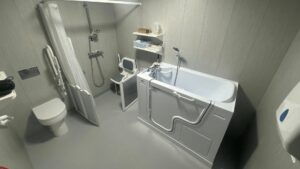
We’d usually guide a wheelchair user towards a wet room or shower, but if you’d prefer to keep bathing, we’ll make it as safe and accessible as we can. Our walk-in baths, built for easier transfers to accommodate wheelchair users, include the Tranquility, with easy slide-in access and a wide door, and the Montana, with a wide-access door and a powered seat set at the right height for a sideways transfer. An optional rising seat can gently lower and raise you into the water. For a full-length, standard bath experience, the Omega is not a walk-in bath, but it is an accessible product that includes a powered seat, which will start outside of the bath, lift a user, and slowly put them into the bath.

What Should You Consider Before Adapting a Bathroom for a Wheelchair User?
Beyond the type of solution, the right design comes down to the person it is for: their mobility, their preferences, any other conditions, and whether they’ll use the bathroom alone or with help. These are the questions we work through at the design stage, because no two wheelchair users have the same needs.
A few things matter most:
- Mobility and personal preference: How much someone can transfer, stand, or bear weight shapes which solution works best for them, and preference counts just as much. Some people simply want to keep bathing; others prefer the freedom of step-free access.
- Other conditions or visual impairment: Wheelchair use rarely comes alone. If someone is also visually impaired, for example, we use strong colour contrast between the fittings, walls, and floor, along with bright lighting, so everything is easy to see and judge.
- Independent use or a carer’s help: If a carer or family member will assist, the room needs space for two to move comfortably. This is where a level-access wet room comes into its own, giving both the user and their carer the access and room they need to both be safe.
- Getting to the bathroom: The route matters as much as the room. Measure the wheelchair before any work is planned, especially a powered chair, and check the hallway, the door and any thresholds that could be in the way. Lever handles are easier to use than round knobs, and a level threshold at the bathroom door avoids a lip to bump over. Ramps, stairlifts and wider hallways sit outside what we fit, but your council can arrange a needs assessment, often with an occupational therapist, to advise on the rest of the home.
What Size and Dimensions Does a Wheelchair-Accessible Bathroom Need?
As a guide, a wheelchair-accessible bathroom needs a clear turning space of around 1500mm x 1500mm and a doorway at least 775mm wide, so a wheelchair can get in and turn freely. These benchmarks come from the UK Building Regulations (Approved Document M), the recognised standard for accessible design.
The key measurements to consider and plan around are:
- Turning space: About 1500mm x 1500mm of clear floor for a full 360° turn.
- Doorway: A clear opening of at least 775mm, ideally 800mm or more for larger or powered chairs.
- Doors: Outward-opening or sliding, so no floor space is lost and no one can be trapped behind a door.
- Level shower: A step-free showering area of around 1200mm x 1200mm.
- Toilet: Roughly 750mm of clear space to one side for a sideways transfer, with a raised seat (about 450mm to 480mm high).
These are helpful starting points rather than strict rules; they’re written for new builds, while a home adaptation is tailored to the person and the space you have, which is exactly what our team work out at your free home design visit.
What Adaptations Make a Bathroom Wheelchair-Accessible?
A handful of well-chosen adaptations do a lot of the work in a wheelchair-friendly bathroom: grab rails, a shower seat, wall-hung basins, comfort height toilets, and non-slip flooring. Each of these removes a specific everyday difficulty, and we make sure to plan these into our installations from the start if a customer would like them added.
For a more in-depth look at the adaptations we fit most often during our installations, and how often each one appears, see our guide to bathroom adaptations for older adults.
- Grab rails give a secure handhold exactly where balance and transfers matter most, beside the toilet, in the shower, or by the bath. Placed and fixed correctly, they make every movement safer; our guide to bathroom grab rails covers where they work best.
- A shower seat lets you wash sitting down, safely and comfortably. We fit sturdy, slip-resistant options to suit different needs and weights, from the 2000 Series with armrests (up to 25 stone) to the wooden slatted seat (up to 40 stone) and the Onyx (up to 31 stone).
- Wall-hung basins and comfort-height toilets are set at the right height for seated use, with clear space beneath the basin so a wheelchair can pull in close. Comfort-height or rise & fall toilets make transfers much easier; our guide to higher toilets, as well as Kate’s level access wet room installation that we completed, can provide more information on how useful they can be for wheelchair users.
- Non-slip flooring gives stable footing for safe transfers between the wheelchair and the toilet, seat, or shower. We fit specialist bathroom flooring that grips even when wet; our guide to wet room flooring for disabled users goes further into the benefits.

How Much Does a Wheelchair-Accessible Bathroom Cost?
The cost depends on the solution and the scope of the work, but as a guide, here are our starting prices for a fully installed accessible bathroom:
- Walk-in Baths: From £7,353
- Walk-in Showers: From £8,500
- Full Wet Rooms: From £10,000
Wet rooms sit at the higher end because they involve the most work: fully waterproofing (tanking) the room, relaying the floor for level access, and often re-designing the whole layout of the space. The final figure always depends on your needs and your space, which we set out clearly in your free, no-obligation quote, so there are no surprises.
Linda’s wheelchair-friendly wet room conversion shows what a more involved project can include: we removed a wall to open up the space, extended the bathroom, and replaced her old step-up shower with a level-access wet room, all completed in seven days.
Making a bathroom safer shouldn’t have to be paused due to financial blockers, though. Many of our customers qualify for VAT exemption, removing the 20% VAT, which can help towards total costs.
We also offer flexible finance options for our customers. For a full breakdown on how to fund a mobility bathroom, our recent post will provide all you need to know.
Bathrooms for Wheelchair Users: A Summary
Adapting a bathroom for a wheelchair user comes down to safe, step-free access and more room to move. Here’s a quick recap of what we have been through in this guidance:
- The best solution: For most wheelchair users, a level-access wet room is the top choice, then a walk-in shower, then a walk-in bath.
- Why the wet room wins: It’s completely step-free with room for a carer and includes a wet room floor, grab bars, and a seat within the full installation cost.
- Walk-in baths: Still an option if you’d rather keep bathing, the Tranquility and Montana products have wide doors for easier wheelchair transfers.
- Key dimensions: Allow a 1500mm x 1500mm turning space and a doorway of at least 775mm, ideally 800mm.
- Helpful adaptations: Grab rails, a shower seat, wall-hung basins, comfort-height toilets and non-slip flooring.
- Starting prices: Walk-in baths from £7,353, walk-in showers from £8,500, and full wet rooms from £10,000, with VAT exemption and finance both options to explore.
FAQs Around Bathrooms for Wheelchair Users
Can a wheelchair user use a walk-in bath?
Yes, some wheelchair users can, with the right model. A walk-in bath with a wide door and an optional rising seat lets you transfer a lot more easily and bathe while seated. That said, for completely step-free access, a wet room is usually the more practical choice.
How wide does a doorway need to be for wheelchair access?
A doorway needs a clear opening of at least 775mm to meet UK accessibility guidance, though 800mm or more is even better, particularly for larger or powered wheelchairs. Outward-opening or sliding doors help too, by keeping floor space clear.
What is the difference between a walk-in shower and a wet room?
A walk-in shower has a low anti-slip tray with a small step (from 40mm), while a wet room is completely level, with no tray or step and the whole floor is waterproofed. For a wheelchair user, a wet room offers fully step-free access, making it the easier of the two to use.
Create a Wheelchair-Accessible Bathroom You Can Rely On
Every wheelchair user deserves a bathroom that’s safe, comfortable, and genuinely their own, and the right design can provide just that. Whether that’s a level-access wet room, a walk-in shower, or a walk-in bath, the best solution is, at the end of the day, shaped around you and your needs.
At Age Care Bathrooms, we design and install accessible bathrooms for wheelchair users across England and Wales, and we’d be glad to use our expertise to help you and adapt the home that you love.
From a free home design visit and a custom 3D design through to expert fitting by our own employed team, we handle everything, and we’ll only ever recommend what truly suits your requirements.
To talk it through, call our friendly team on 0800 999 8994, or book in your free home visit by filling out the form below!