 Skip to content
For many of us, the bathroom is where a little extra safety makes the biggest difference. When getting around starts to become harder, whether through age, a health condition or an injury, everyday washing can start to feel difficult. If that sounds familiar to you or to someone you love, you certainly aren’t alone.
At Age Care Bathrooms, we’ve spent years designing and fitting accessible bathrooms for people across England and Wales. In that time, thousands of people have contacted us about making their bathroom safer and told us why they need it. Those conversations have taught us a great deal about how the right bathroom helps with different mobility problems, and which features matter most for each one.
So how do accessible bathrooms help with mobility problems? In short, they replace the everyday hazards that make bathing and washing difficult with safe, step-free access, secure seating and support adaptations. The result is a bathroom that helps you stay independent, comfortable and confident in the home you love.
In this guide, we’ll explain what makes a bathroom accessible, how these bathrooms help with mobility problems, and the most common reasons people come to us, drawn from our own enquiry data. We’ll look at the best solution and key features for five common conditions and answer the questions we’re asked most, including cost.
Let’s get started!
Contents
How common are mobility problems in the UK?
Mobility problems are very common in the UK, and they are becoming more common over time. Around 1 in 4 people, roughly 16 million, now live with a disability, according to the government’s Family Resources Survey. Of all the types of difficulty people report, problems with mobility are the most common of all, as the national charity Activity Alliance shares.
The numbers have been climbing for years, with around 3.9 million more disabled people today than there were a decade ago, a rise linked in large part to our ageing population.
Mobility problems also become far more likely later in life. About 45% of adults over State Pension age live with a disability, and among older people who do, a mobility difficulty is the most common kind by a wide margin, according to Scope.
So if you or someone you love is starting to find the bathroom harder to use, you are in very good company. It is one of the most common reasons people choose to adapt their home, so they can carry on living safely and comfortably in the place they know best.
What is an accessible bathroom?
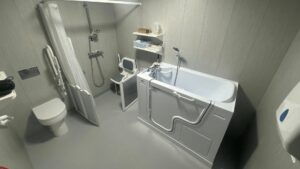
An accessible bathroom is one designed to be safe and easy to use for someone with reduced mobility, illness or disability. It removes the everyday hazards, like a high bath side or a slippery floor, and replaces them with step-free access, secure seating and other supportive features, so bathing feels much safer. You may also hear it called a mobility bathroom.
There is no single design or standard, because every home and every person is different. Most accessible bathrooms are built on one main solution, which could be: a walk-in shower with a low or level entry, a walk-in bath with a low threshold and a built-in seat, a fully waterproof wet room with a completely level floor, or a full mobility bathroom that brings these solutions together in one redesign of the bathroom.
Whichever suits you best, the same thoughtful features are designed into the room, including:
- Step-free, level access, so there is nothing to climb over or trip on.
- Grab rails are fitted exactly where they give the most support.
- A shower seat for washing comfortably while seated.
- A comfort-height toilet, set a little higher than a standard one at around 450mm (about 18 inches) from the floor, makes sitting down and standing up easier on the knees and hips.
- Non-slip flooring that stays safe underfoot, even when wet.
- Thermostatic taps that keep the water at a safe temperature, so it cannot suddenly run scalding hot.
- Easy-reach taps and controls that are simple to use with limited grip or strength.
- Good, even lighting, so the whole room is easy to see clearly, which helps with confidence, balance and judging distance.
These features are planned together as one bathroom, rather than added piece by piece; of course, it depends on personal preference and needs too. Everything is meant to sit in the right place for each user, and the room still looks and feels like a part of the home.
Our guide to bathroom adaptations for the elderly looks at each of these changes and how often we fit them in our installations.

How do accessible bathrooms help with mobility problems?
Accessible bathrooms help with mobility problems by removing the parts of an ordinary bathroom that are hard or risky to use and replacing them with safer, easier alternatives. In short, washing becomes safer, more comfortable and something you can do independently again, often for many years to come.
Here is how accessible bathrooms work in practice:
- They make washing safer. Step-free access removes the high bath side to climb over, non-slip flooring and well-placed grab rails give you something steady to hold, and thermostatic taps keep the water at a safe temperature. Together, these lower the everyday risk of slips and scalds.
- They help you stay independent. With a seat to wash on and controls within easy reach, many people can bathe on their own again, instead of waiting for someone to help.
- They protect dignity. The bathroom is the most private room in the home, so being able to use it without help lets people keep their privacy and their confidence.
- They are more comfortable. Sitting to shower, easy-to-use controls, and a warm, step-free space take much of the effort and strain out of washing.
- They leave room for a carer. Where someone does need a hand, the room can be designed with space for a carer to help safely and comfortably.
An accessible bathroom is also a way to plan. As it is built around a person’s needs, it keeps working as those needs change over time, which helps people stay in the home they love rather than face a move.
Also, it is not only the person using it who feels the benefit. Many people who contact us are a husband, wife, son or daughter looking out for someone they care about, and knowing the bathroom is safe gives them real peace of mind too.
The most common mobility problems people ask us about
The mobility problems people come to us with are wide-ranging, but a clear pattern emerges, and it may surprise you. Most people do not begin with a medical diagnosis at all. By far the most common thing we hear is simply that getting in and out of the bath, or standing long enough to shower, has become a daily struggle, often through general frailty as the years go by.
Around 1 in 5 of the reasons people have given us describe general mobility difficulty of this kind, and about 1 in 8 describe age-related frailty.
When people do name a specific mobility issue, five come up most often: dementia, being a wheelchair user, stroke, problems with balance, and arthritis. Each suits a slightly different accessible bathroom solution, which we look at one by one below in this post.
A quick point on these figures. They come from our own enquiry records and reflect the roughly 1 in 10 enquiries where someone has given us a specific medical condition as the need for an accessible bathroom. They are a guide to what we hear most often rather than exact medical data, and because some enquiries mention more than one condition, shares do not add up to 100%.
| Mobility problem | Share of enquiries* | Best-suited solution | Key features to consider |
|---|---|---|---|
| Dementia or Alzheimer's | ~8% | A wet room or walk-in shower with level access | Simple, consistent controls; strong colour contrast; grab rails; a seat; good lighting |
| Wheelchair users | ~8% | A level-access wet room | Step-free roll-in access; room to turn; a wider doorway; a wall-mounted seat; an accessible basin |
| Stroke | ~5% | A walk-in shower or wet room with seating | Grab rails placed for one-sided weakness; a shower seat; easy lever taps; level access |
| Balance, dizziness or vertigo | ~4% | A level-access walk-in shower with a seat | A secure seat to wash on; well-placed grab rails; non-slip flooring; step-free entry |
| Arthritis | ~3% | A walk-in shower, or a walk-in bath for warm-water relief | Easy-turn lever taps; a seat; grab rails; low or level access; a comfort-height toilet |
*Share of the enquiries where someone gave a specific reason. Some mention more than one, so these do not total 100%.
How accessible bathrooms help with five common mobility issues
Every accessible bathroom shares the same core features, but the details that matter most change from one person to the next. Here is how the right design helps with five of the most common reasons people come to us, starting with the most frequent.
Dementia and Alzheimer’s
For someone living with dementia, an accessible bathroom helps by making the room simpler, clearer and safer to use. Around 8% of the people who give us a specific reason mention dementia. Strong colour contrast, such as a coloured toilet seat or grab rails against pale walls, makes each fixture easier to spot and recognise. Simple, consistent controls are easier to manage, good lighting removes the confusing shadows that can unsettle someone, and level access with well-placed rails keeps bathing safe. The solution that usually works best is a level-access wet room or a walk-in shower.
For more details about accessible bathrooms for people with dementia, see our guide to designing a dementia-friendly bathroom.
Wheelchair users
For a wheelchair user, an accessible bathroom helps most by removing every barrier to getting in and moving around. Wheelchair users also make up around 8% of the specific reasons we hear. A level-access wet room is usually the ideal choice, with a completely flat floor to wheel straight into, enough space to turn, and a wider doorway where needed. A wall-mounted or fold-down seat makes transfers easier, an accessible basin/sink leaves room to get close, and grab rails give support at key points in the bathroom. You can read more in our guides to bathrooms for wheelchair users and wheelchair accessible showers.
Stroke
After a stroke, an accessible bathroom helps by giving support exactly where it is needed, so washing feels manageable again. Around 5% of the reasons people give to our customer care team relate to a stroke. As a stroke often causes weakness down one side of the body, grab rails are positioned on the person’s stronger side, within easy reach, so they can push up and steady themselves. A sturdy shower seat, level access, easy-to-use lever taps and thermostatic controls all add to the safety and comfort. A walk-in shower with seating usually suits best. Our guide to bathroom adaptations after a stroke explains more.
Balance, dizziness or vertigo
For anyone who feels unsteady, an accessible bathroom helps by taking away the need to stand unsupported. Around 4% of the reasons people give us involve balance problems, dizziness or vertigo. Being able to sit down to wash makes a real difference, so a secure shower seat is the key feature, backed by well-placed grab rails to hold, non-slip flooring underfoot, and step-free entry so there is nothing to try and climb over. Here, a level-access walk-in shower with a built-in seat is usually the safest choice that our team recommends. Our guide to shower seating options covers the different seats available.
Arthritis
For someone living with arthritis, an accessible bathroom helps by taking the strain and effort out of washing. Around 3% of the reasons people give to our team relate to arthritis. Getting in and out of a bath is often the hardest part, so a low or level access walk-in shower removes the high side to climb over. Easy-turn lever taps are a must as they are far kinder to stiff or painful hands, while a seat, grab rails, and a comfort-height toilet reduce the strain on sore joints. For those who love a soak and bath, a walk-in bath filled with warm water can really help with stiffness and aching joints, one of the benefits of hydrotherapy for arthritis. See our arthritis bathroom tips for more.
Whatever the reason, the right bathroom always starts the same way: with a free home visit, where we listen first and suggest what we think works best for you.
How much does an accessible bathroom cost?
The cost of an accessible bathroom depends on the type you choose and the features you need, but as a guide, our walk-in baths start from £7,353, walk-in showers from £8,500, and full wet rooms from £10,000. Every home is different, so the surest way to get an accurate price is a free home visit, where we measure up and talk through the various options with you. We always show prices up front, with no hidden extras.
If you’re an older or disabled person or living with a long-term illness, and the work is for your own home, you will be VAT exempt on the relevant products and installation under HMRC rules. In other words, you will not pay the 20% VAT on that part of the work. It is not a special offer or a discount, but simple relief you may be entitled to, and you can claim it in a couple of minutes with our VAT exemption checker.
Flexible finance is available too, if you would rather spread the cost, and it is always entirely optional. You can see all the ways to pay, and if it helps, read our honest comparison of the cost of adapting your bathroom versus care home fees.

How do accessible bathrooms help with mobility problems: A summary
- Mobility problems are common and increasing. Around 1 in 4 people in the UK live with a disability, and difficulty with mobility is the most common kind, especially in later life.
- An accessible bathroom removes everyday hazards. Also called a mobility bathroom, it replaces things like a high bath side or a slippery floor with step-free access, secure seating and supportive features.
- There is a solution to suit most needs. The main options are walk-in showers, walk-in baths, wet rooms and full mobility bathrooms, each designed around the person who will use it.
- They help in more ways than one. The right bathroom makes washing safer, protects independence and dignity, adds comfort, leaves room for a carer, and helps future-proof the home.
- Most people come to us with a struggle, not a diagnosis. When a specific condition is named, the most common are dementia, wheelchair use, stroke, balance problems and arthritis, and each suits a slightly different design.
- Prices are clear and start from £7,353. Walk-in baths start from £7,353, walk-in showers from £8,500 and wet rooms from £10,000, and you will be VAT exempt if you are eligible.
- Every project begins with a free home visit. We listen first, give honest advice, and never put you under any pressure.
Frequently asked questions about accessible bathrooms for mobility problems
What is the best bathroom for someone with limited mobility?
There is no single best option because it depends on each person’s needs, but a walk-in shower with level access suits most people and is a very popular choice with our customers. For wheelchair users, a level-access full wet room is a go-to option, while anyone who enjoys a long relaxing soak may prefer a walk-in bath with a built-in seat. The best way to decide for you is with a free home visit, where our experts look at your space and can suggest what will work for your home.
Can I get VAT relief on an accessible bathroom?
Yes. If you are an older or disabled person, or living with a long-term illness, and the work is for your own home, you will be VAT exempt on the qualifying products and installation under HMRC rules. This means you will not pay the 20% VAT on that part of the work. It is a relief you may be entitled to rather than a “discount”, and you can check your eligibility in a couple of minutes with our VAT exemption checker.
Will an accessible bathroom help me stay in my own home?
Yes, for many people, that is exactly what it helps you to do. A safer, more accessible bathroom often removes the main reason someone might otherwise need to move or go into care, letting them stay independent and comfortable in the home they love for longer. Our comparison of the cost of adapting your bathroom versus care home fees looks at this in more detail.
How long does it take to install an accessible bathroom?
Most accessible bathrooms are installed in around three to five days, depending on the size of the project, with a large wet room conversion, as an example, may take the full 5 days. Our own employed team carries out the work, keeping things clean and tidy throughout, and takes the old bathroom away when finished. We also keep a toilet in place for most of the work, so you are only ever without one for the short time it takes to fit the new one.
Which areas do you cover?
We design and install accessible bathrooms across England and Wales, with the only exception being Cornwall, which we do not currently cover. Wherever you are within that area, the service is the same: a free home visit, a custom 3D design so you can see your new bathroom before work begins, and installation by our own DBS-checked team.
Ready for a safer, more accessible bathroom?
If you or someone you love would find bathing easier and safer with a few thoughtful changes, we are here to help, with no pressure and no obligation. It all begins with a free home visit, where we listen to what you need, measure up, and create a custom 3D design so you can see your new bathroom before any work begins. Every installation is carried out by our own employed, DBS-checked team, and we will always give you honest advice and clear pricing up front, then leave the decision entirely with you, in your own time.
At Age Care Bathrooms, we don’t just fit mobility bathrooms; we help you stay safe, independent and comfortable in the home you love.
To book your free home visit, or simply talk things through, call our friendly team today on 0800 999 8994, or fill out the form below!