 Skip to content
A warm bath is deeply comforting for many, the one time of the day when you can truly switch off, and let the steam clear our heads. As we get older, that “soak” becomes even more valuable for easing aches and pains that seem to settle in a little more than they used to.
However, at Age Care Bathrooms, we often have serious conversations with our customers and their families about a topic that many overlook: water temperature. What felt nice and relaxing during our younger years can actually become quite dangerous as we age.
When caring for a loved one, or if you’re looking to future-proof your own bathroom, understanding what a safe bath temperature is for seniors or those with disabilities can be just as important as installing a grab rail or non-slip flooring. It is less about comfort and more about protecting skin that has become more delicate.
In this guide, we are going to look at why the “perfect” temperature changes as we get older, what official health guidelines say, and new, clever bits of technology that can remove the guesswork!
Let’s get started…

Why Should the Elderly Take More Care with Bath Temperatures?
You might wonder why we need a specific guide to bath temperatures for the elderly, but there are several biological and health-related reasons as to why it is essential. Those of older age are at a much higher risk of scalding or heat-related distress than younger adults.
1) Changes in Skin Health
As we age, our skin naturally becomes thinner and loses some of its fatty underlying layer. This “tissue-paper” like skin is far more delicate than it used to be. This allows heat to penetrate the layers much faster, meaning that a temperature that may have only caused a bit of redness on a 30-year-old, for example, can now cause a significant burn on a senior in seconds.
2) Reduced Sensitivity to Heat
Perhaps the most hidden danger. Various conditions that affect us in later life, like diabetes or peripheral neuropathy, can cause a loss of sensation in the hands and feet. If you are testing the water with a hand that has reduced feeling, you might think the water is “just right” when, in reality, it’s scalding hot.
3) Slower Reaction Times
Even if someone notices that the water is too hot, a decline in mobility or a slower reaction time can make it difficult to get out of the situation quickly. If you are struggling with balance, trying to scramble out of a hot bath in a hurry is a recipe for a dangerous fall.
4) Heart and Blood Pressure Considerations
Sitting in water that is too hot can cause your blood vessels to dilate quickly, leading to a sudden drop in blood pressure. For a younger person, this might cause a bit of lightheadedness. However, for an elderly person, especially those on blood pressure medication, it can lead to fainting or prolonged dizzy spells while they are still in the water, which is very dangerous.
Taking an extra bit of care isn’t about being over-cautious; it is about acknowledging that our bodies process heat differently as the years go by.
In the next section, we’ll look at the “magic numbers” for the best bath temperature to keep you safe and comfortable.
What is the Ideal & Safe Bath Temperature for the Elderly?
When we talk about the average bath temperature for a healthy adult, most people tend to settle somewhere around 37°C to 38°C, which is roughly body temperature. However, when we are considering the best or safest temperature for a senior with limited mobility, the margin of error is smaller.
The NHS and Health and Safety Executive (HSE) provide very clear guidelines to prevent the risk of scalding. For a bath, the maximum recommended temperature at the tap is 44°C.
Although just because 44°C is the maximum safe “outlet” temperature, it does not mean that it is the ideal temperature for everyone to sit in. For most elderly users, we recommend aiming for a range between 37°C and 39°C. This is warm enough to be therapeutic and relaxing for the muscles, but remains well below the threshold where skin damage or heat exhaustion becomes a risk.
We’ve put together a quick temperature guide below:
Safe Bath Temperature Guide:
- The “Body Match” (37°C): Feels neutral and safe; perfect for those with very sensitive skin or circulatory issues.
- The Optimal Range (38°C – 39°C): The “sweet spot” for most seniors. Comfortably warm without being taxing on the heart.
- The Caution Zone (40°C – 42°C): Can be used for short periods, but requires constant monitoring to ensure no dizziness or skin redness starts to occur.
- The Danger Zone (43/44°C+): Anything above this is considered too hot for seniors and poses an immediate risk of scalding, especially if the person cannot exit a bath quickly.
Bath Temperature Safety Guidance for Specific Illnesses and Disabilities
While general guidelines are a great starting point, the “correct” temperature often depends on an individual’s specific health needs.
For People with Dementia
Sensory processing can change with dementia, making hot water feel overwhelming or frightening. Keeping the water at a consistent 37°C helps prevent distress and ensures safety if a user can no longer articulate that they are uncomfortable.
For People with Diabetes and Neuropathy
As we mentioned above, people with diabetes or neuropathy may have less sensation and cannot feel a burn occurring. In this situation, it is vital to check bath temperatures with a thermometer or a carer’s elbow.
For People with Heart Conditions
For those with cardiac concerns, it is recommended to stay close to body temperature with bath water, which prevents unnecessary strain and dizzy spells.
The Role of Thermostatic Mixing Valves and Safe Bathing
If you are looking at your current bathroom and wondering how on earth you are supposed to keep the water at an exact temperature while using standard “hot and cold” taps, you aren’t alone. Balancing two separate streams of water by hand is tricky and a bit of a gamble.
This is where new technology in the form of a Thermostatic Mixing Valve (TMV) becomes an essential part of an elderly person’s bathroom. A TMV is a clever valve that blends hot and cold water before it even reaches your tap or shower head.
Unlike standard taps, which can fluctuate if someone else in the house turns on a kitchen tap or flushes a toilet, a TMV maintains a constant, pre-set temperature. And, another great function is that if the cold water supply fails for any reason, the TMV will automatically shut off the hot water instantly to prevent a “slug” of scalding water from reaching the user of the bath.
At Age Care Bathrooms, we recommend a TMV for every accessible bathroom we design, and more than half of the bathrooms we have fitted include one. It is a fundamental safety feature for any accessible-friendly home.

How Walk-in Baths Can Help Control Temperature for the Elderly
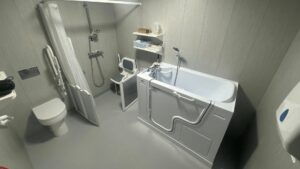
Another great addition for those looking to have a safer bathing time and gain better control of water temperature is a walk-in bath.
Due to their design, users enter the tub while it is empty, close the securely sealed door, and then begin the filling process. This means a user is in direct contact with the water from the very first drop.
To make this safe, our walk-in baths can be fitted with thermostatic temperature control, so the water stays at a steady, safe temperature as the bath fills, without a sudden rush of hot water hitting your feet.
Many of our walk-in bath models include twin-waste systems, meaning the bath drains much faster, reducing the time you spend sitting in cooling water once your soak is over.
Practical Tips: How to Check Your Bath Temperature
Whether you have the latest safety valves installed or not, it is still wise to perform a manual check before anyone steps into the bath. Below are some of our recommended ways to do this:
- The Elbow Test: An old-fashioned method, but it works. Your hands can be quite resilient to heat, but the skin on your elbow is much more sensitive. If the water feels “hot” on your elbow, it’s too hot for someone who is older or has a disability.
- Use a Bath Thermometer: For absolute precision, a digital bath thermometer is a fantastic, inexpensive investment. It removes all the guesswork by giving you an exact reading in seconds. Look for models that have a red light warning if the water exceeds 39°C.
- Swirl the Water: Before testing, make sure you have swirled the water thoroughly. Standard taps can sometimes create “hot spots” where the water hasn’t mixed properly. This could lead to a surprise scald even if the surface feels fine.
- The Cold First Rule: If you don’t have a TMV installed, always turn the cold tap on first and then gradually add the hot water. This ensures that if a person reaches for the water early, they aren’t met with a stream of boiling water.

Safe Bath Temperatures for the Elderly: A Summary
Ensuring a safe and relaxing bath, especially for the elderly, isn’t about removing the joy of a soak; it’s about managing the risks that come with age. Here is a quick recap of the essentials:
- The Ideal Range: Aim for 37°C to 39°C for a safe, therapeutic experience that won’t strain the heart or damage delicate skin.
- Maximum Limit: Never exceed 44°C at the tap, as per NHS and HSE safety guidelines.
- Know the User: Be extra vigilant with those living with diabetes, dementia, or heart conditions, as their bodies may not signal heat-related distress as effectively.
- Safety Tech: Consider installing Thermostatic Mixing Valves (TMVs) or having a walk-in bath to automate the temperature control and provide an emergency shut-off.
- Double Check: Always use the “elbow test” or a thermometer before entry to ensure the water is exactly where it needs to be.
Let Us Help You Create a Safer Bathroom
At Age Care Bathrooms, we know that the bathroom is one of the most important rooms in the house for maintaining your dignity and independence. We don’t just install bathrooms; we install peace of mind.
Our goal is to make sure you can enjoy your soak without a single worry. If you are concerned about your current setup, or if you are looking to modernise a bathroom for a loved one, we are here to help.
We offer a completely free, no-obligation consultation where we can look at your current plumbing and show you how simple it can be to create a safer, more comfortable space.
Give our team a call today on 0800 999 8994, or fill out our contact form to start your journey.
We Cover the Whole of England & Wales
Our head office is in Chesterfield, Derbyshire, and our employed, DBS-checked installation teams travel right across England and Wales.
We don't currently cover Scotland, Cornwall, or the Plymouth and Torbay areas. Pop your postcode in below to check we can visit you.
- Free home visit
- No obligation
- Employed, DBS-checked fitters
Not sure? Call us free on 0800 999 8994 and we'll confirm.
Let's get you a free home visit booked in with one of our expert surveyors