 Skip to content
When a loved one is diagnosed with dementia, the focus shifts to their safety within their own home. At Age Care Bathrooms, our team have sat with many families who have felt overwhelmed, wanting to ensure that their parent or partner can be independent for as long as possible. The bathroom is a big part of this; once a place of normal routine, it can become a source of confusion or fear for those with dementia.
According to the Alzheimer’s Society, there are currently around a million people living with dementia in the UK, a number that is projected to rise to 1.4 million by 2040, highlighting just how important this conversation is.
In this guide, we will draw from our years of experience as accessibility bathroom specialists to show you how a dementia friendly bathroom can transform daily life. We’ll look at the science of colour, the necessity of intuitive design, and how to create a bathroom space that supports both safety and dignity.
Understanding the “Dementia Brain” & The Ideal Bathroom Scenario
To design the perfect bathroom for someone with dementia, it is important to understand the sometimes hidden symptoms of the condition, all of which can be found via the NHS. Dementia often affects the brain’s ability to distinguish between surfaces, judge distances, or manage complex tasks, amongst many others, including:
- Reduced Depth Perception: A dark rug on a light floor, as an example, can look like a hole in the ground, causing a person to stop suddenly or trip over.
- Sensitivity to Glare and Shadows: Highly reflective tiles or poor lighting can create shadows that look like physical obstacles.
- Cognitive Overload: Too many chrome fixtures or buttons that appear hidden can make a simple task like turning on a shower feel impossible.
The Best Case Scenario for a Dementia Friendly Bathroom
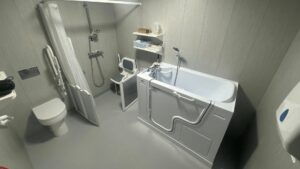
If the team here were to describe the ideal bathroom for a person with dementia, it wouldn’t look like a hospital ward. Instead, it would be a high-contrast, clutter-free, and brightly lit space, suited to that customer’s requirements.
This bathroom set-up would include:
- Everything is Visible: The toilet, sink, and shower are clearly distinguishable from the walls and floor.
- Everything is Intuitive: Taps are traditional levers, not complicated digital dials which can confuse.
- The Environment is Calm: There are no busy patterns on the floor and no large mirrors that might cause the user to become startled by their own reflection.
- Safety is “Invisible”: Features like thermostatic valves and non-slip floors are built into the design and installation, protecting without making the bathroom feel clinical.

The Science of Colour in Dementia Friendly Bathrooms
Colours in a dementia friendly bathroom are perhaps the most technical aspect of the design. Most people would be looking for a nice palette; however, in our world, colour is a functional tool used to create visual contrast.
The Importance of Light Reflectance Value (LRV)
To make sure a bathroom is safe, we look at the LRV, also known as the Light Reflectance Value of materials. This is a scale from 0 to 100 that measures how much light a surface reflects. For someone with dementia to see an object clearly, according to Gerflor, there should be a minimum of 30 points of difference in LRV between the object and its background.
To make this clearer, we’ve listed some bathroom examples below:
- The Toilet: If you have white panels on the bathroom wall, a standard white toilet can “disappear” into the wall. By simply installing a high-contract blue or red toilet seat, a clear target is introduced, reducing the risk of falls or misses.
- Grab Rails: These should never be chrome in a dementia-friendly bathroom if the wall of the bathroom is a light colour. We often recommend rails that are blue or yellow, which will stand out against the wall, making them easier to find.
- Flooring vs Walls: The floor should be a consistent, matte colour that contrasts sharply with the walls. This can help the user clearly define where the floor ends and the wall begins, which aids their balance.
Following research done by the DSDC (Dementia Services Development Centre) utilising products with calming, high-contrast colours, can reduce agitation and promote a sense of “knowing where you are” for those with dementia.
What to Avoid: The Common Mistakes in Dementia-Friendly Design
Creating a bathroom for a person with dementia is, at times, as much about what you remove as what you add. Due to the brain processing visual information differently, certain standard bathroom features can cause distress or accidents.
Based on our experience at Age Care Bathrooms, here are our top things to avoid:
- Busy Patterns and Speckled Floors: To someone with dementia, a dark speckle on a light floor can look like coins or dirt they need to pick up, leading to a fall. Similarly, bold stripes or patterns can appear to move or look like a physical barrier.
- Highly Reflective Surfaces: Glossy wall tiles or shiny, polished floors can create significant glare. This isn’t only distorting, but a shiny floor may look wet or slippery to a person with dementia, causing them to hesitate or lose balance.
- Large Mirrors in the Wrong Place: While we need mirrors to shave or brush our teeth, a person in later stages of dementia may not recognise their own reflection. This may cause them to think a stranger is in the room with them, causing extreme anxiety. We often recommend “hide-away” mirrors or placing them at a height that can be covered.
- Dark Floor Mats: As we briefly mentioned before, a dark blue or black bath mat on a white floor can look like a deep hole. A user may try to jump over it or avoid it completely, resulting in a major trip hazard.
- Concealed Controls: Bathrooms with a minimalist design often hide shower valves or use touch-sensitive buttons. For someone with dementia, simple is always better. Traditional lever taps with clear blue and red markings are far better than modern, hidden controls.
Five Essential Safety Features for Peace of Mind
Making the bathroom accessible and safe for our customers is the number 1 priority for us. When we install a bathroom for someone with dementia, we look to incorporate safety measures that protect them without making the room overwhelming.
Many of these are changes we fit across all our installations; our guide to bathroom adaptations covers the full set.
Here is our list of must-have accessibility features for a dementia friendly bathroom:
1) Thermostatic Mixing Valves (TMV3)
The loss of temperature sensitivity is a common symptom of dementia. A person may not realise the water is too hot until the skin is already scalded. In our installations, we install TMV3 valves, which ensure the water never exceeds a safe temperature, regardless of how the taps are turned.
2) Flood Prevention Wastes
Forgetfulness can lead to taps being left running. Installing a “flood-proof” basin is a good solution to this. These have built-in pressure sensors that will open the plug automatically if the water reaches a certain level, preventing dangerous overflows.
3) Coloured Grab Rails
Building on the LRV principles we discussed, grab rails are essential. However, we make sure to avoid standard Chrome ones. Instead, we use rails in bold, matte colours, which provide a clear visual aid, making sure the user can instantly see exactly where to hold for support.
4) Consistent Lighting
Shadows can be terrifying for someone with dementia. By using high-frequency, flicker-free LED lighting designed to provide an even spread of light across the room, dark corners are eliminated, and the chance of optical illusions is reduced.
5) High-Contrast Shower Seats
In a standard shower, the standing-up element is often a tiring part of the process. For a person with dementia, fatigue can lead to confusion. We would recommend installing a sturdy, wall-mounted shower seat as a standard feature for the bathroom. It is also more than a place to rest; the shower seat should be a contrasting colour, which will help a user focus on washing without the fear of losing balance. The shower seat can act as a home base within the shower.

Why Walk-In Showers are the “Go-To” for Dementia Care
If you are renovating with dementia care in mind, the team here at Age Care Bathrooms will recommend a walk-in shower or a level-access wet room over a traditional bath or even a step-in shower tray.
The two main reasons for this are:
- Physical Safety: The climb over a bathtub side is a significant risk factor for falls. By removing the threshold entirely, we create a seamless transition from the floor to the shower. For someone with dementia, who may already be struggling with balance, a walk-in shower is much safer.
- Future-Proofing for Assistance: As dementia progresses, the user may eventually need help from a partner or a professional carer. A walk-in shower provides the space needed for two people to move comfortably. It also allows for the inclusion of a fold-down seat, as we mentioned earlier, a vital feature for those who find standing for long periods tiring.
Our walk-in showers are designed to look like a high-end, modern bathroom. Choosing safety shouldn’t mean sacrificing your or a loved one’s home that you and they love.
Designing Dementia-Friendly Bathrooms: A Summary
At Age Care Bathrooms, we believe that a diagnosis shouldn’t dictate where you or your loved one lives. A home is where memories are, and with the right adaptations, it’s where a person should be able to stay.
Creating a dementia-friendly bathroom is about safety, removing daily barriers that cause frustration, and replacing them with a space that regains confidence. By focusing on these thoughtful, science-led changes, from high-contrast colours to intuitive safety features, making a bathroom dementia-friendly is an investment in independence, ensuring a home stays a home.
Let Us Help You Visualise the Change
Planning for the future can feel like a daunting task, but you definitely don’t have to do it alone. We are here to help you navigate the options and find a solution that works perfectly for your family.
The best way to start is with a free, no-obligation home assessment. One of our accessible bathroom experts will visit you to:
- Understand your specific needs and discuss the daily challenges you’re facing.
- Explore the design possibilities that will work best for your current bathroom layout.
- Create a detailed 3D design and render so you can see and personalise your new bathroom before making any commitments.
Take the first step towards a safer, more accessible bathroom today. Call our team on 0800 999 8994 or fill in the form below!